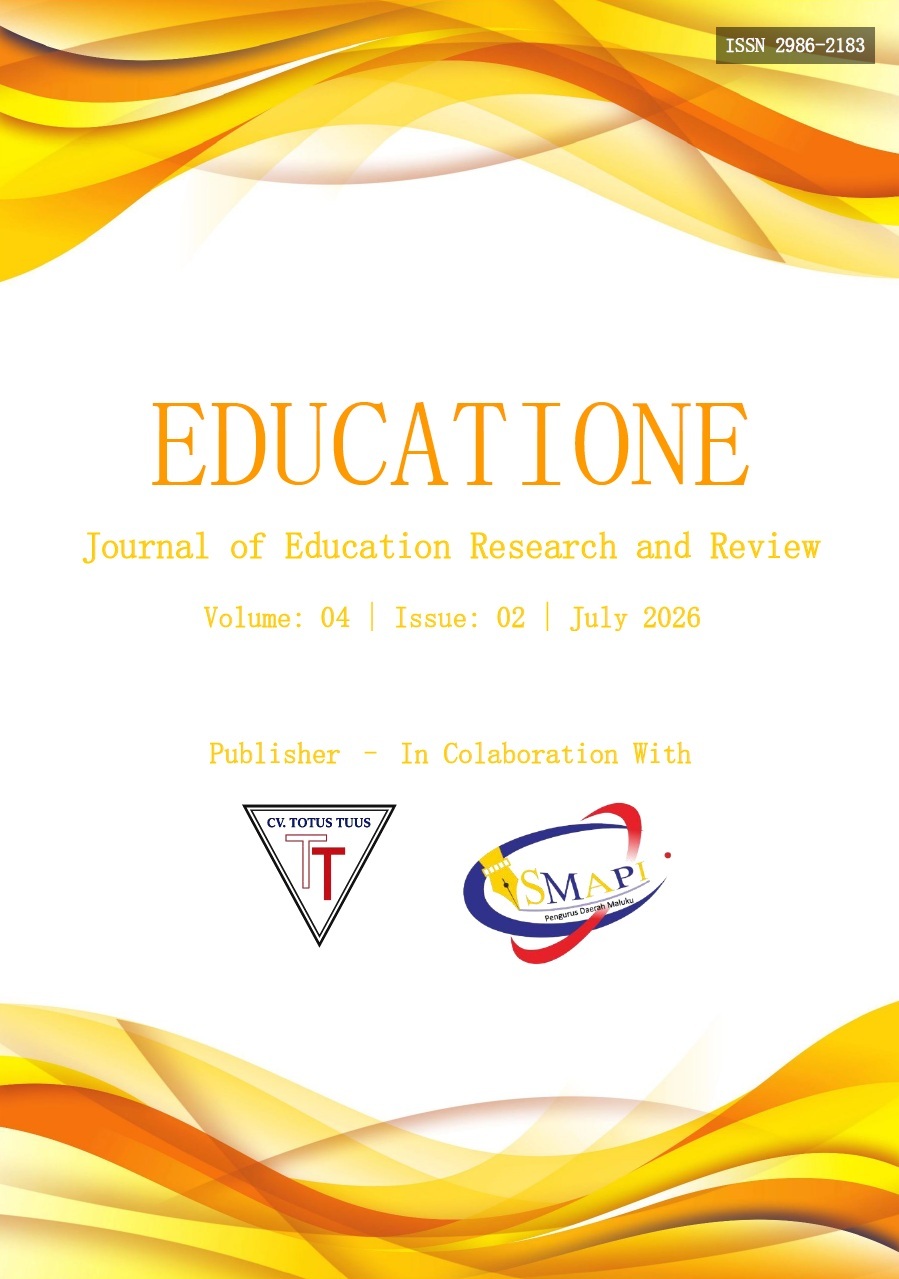
EVALUATING CURRICULUM PROGRAM SUCCESS USING TYLER’S GOAL-ORIENTED EVALUATION MODEL
DOI:
https://doi.org/10.59397/edu.v4i2.218Keywords:
Curriculum evaluation, Curriculum implementation, Educational evaluation, Junior secondary school, Tyler modelAbstract
Curriculum evaluation is essential for determining whether educational programs are implemented in line with intended goals and for identifying areas requiring improvement. This study evaluated curriculum program implementation at SMP Negeri 4 Ambon using Tyler’s goal-oriented evaluation model. The study employed a descriptive quantitative design and involved all 73 teachers at the school through total sampling. Data were collected using a 16-item questionnaire on a five-point Likert scale designed to capture teachers’ perceptions of curriculum objectives, learning experiences, organization of learning experiences, and outcome assessment. The data were analyzed using descriptive statistics. The findings show a minimum score of 68, a maximum score of 80, a mean score of 77.47, and a standard deviation of 4.93. These results indicate that respondents generally perceived curriculum implementation at SMP Negeri 4 Ambon positively and showed relatively consistent responses across participants. Interpreted through Tyler’s framework, the findings suggest that the curriculum program was largely aligned with its intended goals, supported by planned learning activities and a structured evaluation process. However, because the study relied on teacher perceptions and descriptive statistics, the findings should be interpreted as evidence of favorable implementation rather than definitive proof of curriculum effectiveness. The study nevertheless provides a useful school-level evaluation baseline for continuous curriculum improvement.
Downloads
Published
How to Cite
Issue
Section
Citation Check
License
Copyright (c) 2026 EDUCATIONE

This work is licensed under a Creative Commons Attribution 4.0 International License.